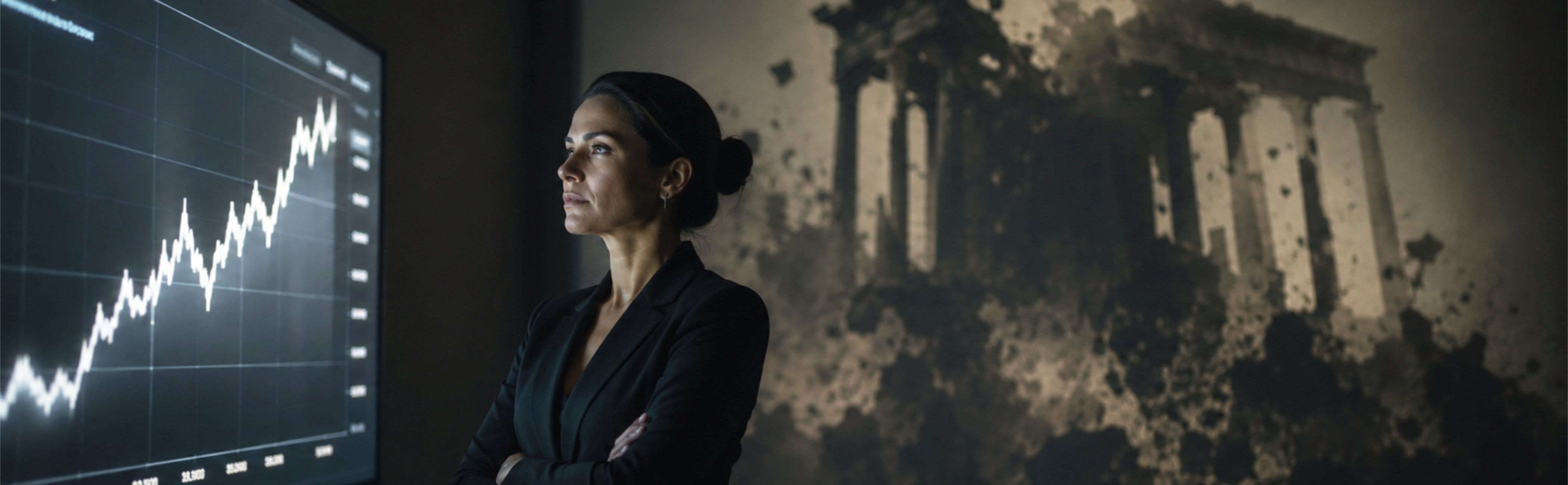
The Fatal Error of The Oracle
Why Misreading Data Can Destroy an Empire
This takes about 4 minutes to read.
Imagine you are at the height of your power. Your markets are stable, your margins are healthy, and your competitors seem small. You feel invincible.
You receive a piece of intelligence: a signal that suggests a massive opportunity for expansion or perhaps a move to crush a rival. It looks like a clear sign of destiny.
You act on it with total confidence. But instead of growing, your empire begins to crumble.
This is not just a story from an ancient textbook; it is a warning for every leader in a modern boardroom.
The King Who Heard Only What He Wanted to Hear
Thousands of years ago, King Croesus of Lydia was one of the wealthiest men in the world. He wanted to expand his influence by invading Persia.
To ensure success, he consulted Pythia, the Oracle at Delphi. He asked if he should go to war. The prophecy was simple yet cryptic: "If you cross the Halys River, a great empire will fall."
Croesus was delighted. He assumed the prophecy meant he would destroy the Persian Empire. He marched his armies forward with absolute certainty.
He was wrong.
The "mighty empire" that fell was not Persia; it was his own. His overconfidence caused him to misinterpret a vague signal, and his decision led to the total collapse of Lydia.
The Perils of Executive Hubris
In large-scale organisations, hubris often wears a professional mask. It does not look like arrogance: it looks like "calculated risk" or "decisive leadership."
When a company reaches a certain size, leaders can become insulated from reality. You stop looking for the truth and start looking for confirmation.
This creates several dangerous blind spots:
- Confirmation Bias: You only look at data that supports your existing strategy.
- The Echo Chamber: Your senior team tells you what you want to hear rather than what you need to know.
- Misinterpreting Ambiguity: You see a market trend and assume it means one thing, while the reality is actually pointing in the opposite direction.
Just like Croesus, many leaders fall into the trap of seeing a "mighty empire" falling and assuming it is their competitor. They fail to realise that they are the ones standing on the edge of the cliff.
The Cognitive Burden: Signal vs. Noise
We live in an era where data is everywhere. For C-suite executives, the challenge is rarely a lack of information; it is the mental exhaustion of trying to find the truth within it.
Having more data is not the same as having more clarity. In fact, the sheer volume of "noise" can make even the most obvious signals look like prophecies from an oracle.
The weight of making high-stakes decisions based on flawed models or biased interpretations is immense. It leads to decision fatigue: a state where leaders either become paralysed by complexity or act impulsively to escape it. Often they simply request more information, another meeting or more analysis.
Building an Empire That Cannot Fail
You should be steering the ship, not drowning in the waves of data.
The goal of a modern leader is not to process more information; it is to possess better insight. You need to move past the "gut feeling" and ensure your strategic roadmap is built on reality, not assumptions.
At DVANA, we act as your strategic navigator. We do not just offer advice: we build the intelligent infrastructure that transforms your raw, chaotic data into a weapon of growth. We combine human expertise with advanced technology to lift the cognitive burden off your leadership team.
We deliver this through three core pillars:
- Robust Processes and Procedures: We design the operational guardrails that ensure consistency. By codifying your excellence, we remove the chaos of human error and prevent uncalculated moves driven by bad data.
- AI-Driven Data Intelligence: We deploy advanced AI to cut through the noise. We take your fragmented data streams and convert them into a high-fidelity source of truth: allowing you to see reality without the distortion of bias.
- Agentic Workflows: We implement intelligent, autonomous workflows that handle the heavy lifting of data monitoring and routine execution. These systems act as your digital vanguard; they manage the complexity so you can focus on high-level vision.
We do not just give you more to think about: we give you the certainty to act.
Secure Your Future
Are you certain that your current strategy is reading the market correctly? Or are you merely seeing what you want to see?
Avoid the mistakes of the past. Let us help you build a roadmap that leads to genuine dominance rather than accidental decline.
Book a strategic consultation with DVANA today and ensure your next big move is the right one.